Heat Exchanger
Jet Flow Technologies not only designs but also manufactures shell and tube heat exchangers for effective heat transfer between two fluids, with one fluid flowing through a bundle of tubes (tube side) and the other circulating around them within an outer shell (shell side). As an expert tube heat exchanger manufacturer, we offer fixed tube sheet, floating head, U-tube, double pipe, and kettle type exchangers for demanding industrial applications across India, Europe, the Middle East, and Southeast Asia. All our units are engineered in compliance with ASME, TEMA, PED, and other international pressure vessel standards to ensure consistent performance in vital processes.
Principle - A heat exchanger is a device built for efficient heat transfer from one medium to another, whether the media are separated by a solid wall so that they never mix, or the media are in direct contact.
How a Shell and Tube Heat Exchanger Works
- Tube-Side Flow In a tube heat exchanger, one fluid flows through a bundle of tubes, carrying heat from or to the process fluid.
- Shell-Side Flow - The second fluid flows around the tubes within the outer shell, enabling continuous heat exchange between the two media.
- Heat Transfer Mechanism - Heat passes through the tube walls without the two fluids mixing, ensuring safe and efficient thermal exchange.
- Baffle Function - Baffles inside the shell direct the fluid flow across the tubes, increasing turbulence and improving heat transfer efficiency.
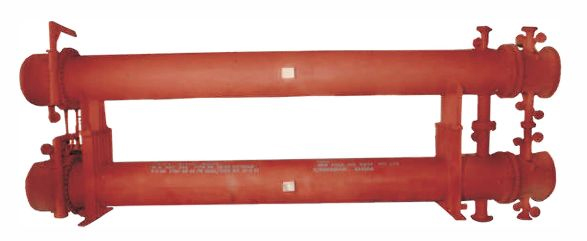
Product Range -
- Fixed Tube Sheet - An extensively used shell and tube heat exchanger design with minimal construction and lower cost, suitable for where shell-side and tube-side fluids operate at similar temperatures
- Floating Head - This tube heat exchanger design enables differential thermal expansion, making it ideal for high temperature variations and allowing easy tube bundle exclusion for maintenance
- U-Tube - A compact configuration that handles thermal expansion effectively with fewer joints, reducing the risk of leakage
- Double Pipe - A basic setup designed for small-scale operations and low flow-rate applications where precise heat transfer is required
- Kettle Type - A specialized shell and tube heat exchanger utilised for reboiling and vaporizing processes in chemical and process industries.
Features -
- Heat Exchanger is available up to Surface area of 2750 m2
- Tube sheet thickness up to 150mm
- Highest sealing get through electronically controlled precision tube expander.
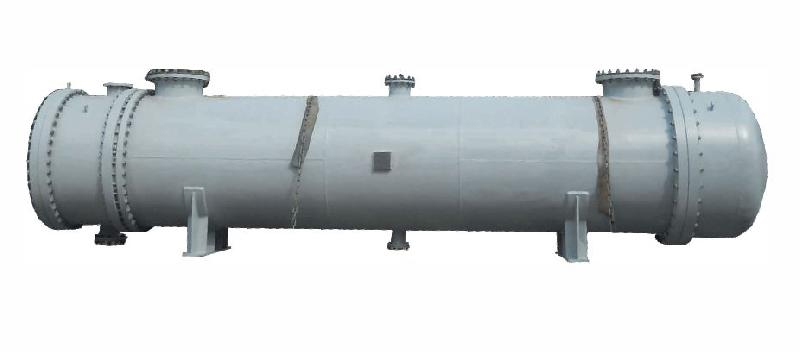
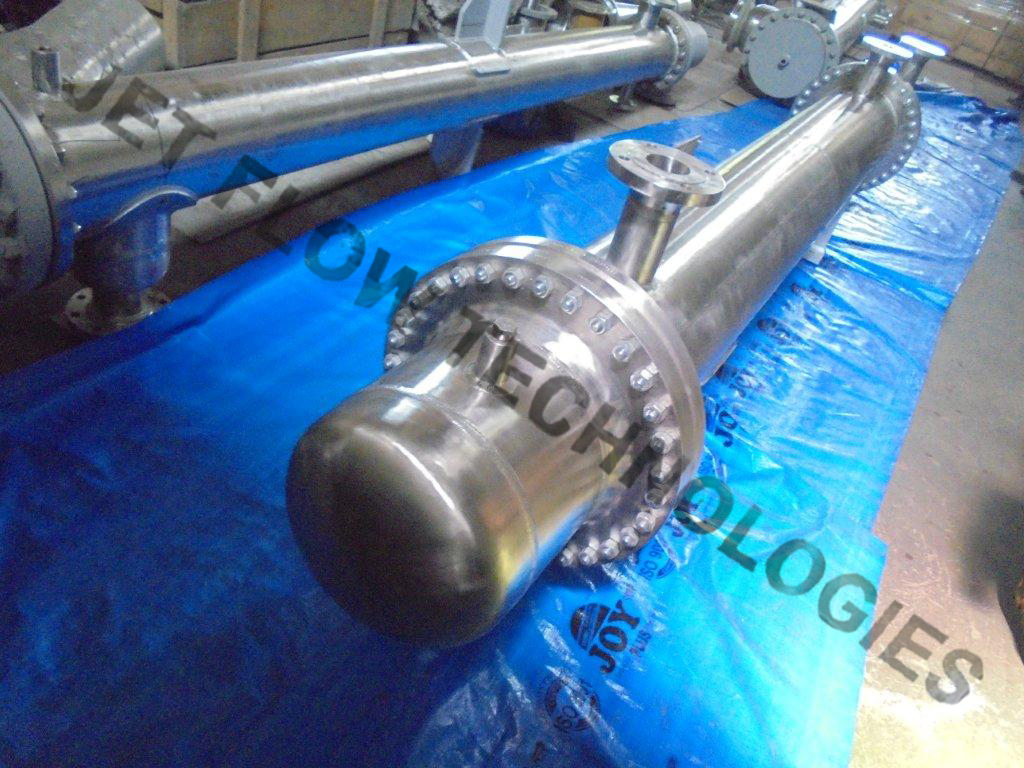
Design Standard and codes -
- ASME Sec VIII with and without "U" Stamp
- TEMA
- ISS 4503
- ISS 2825
- HEI
- PED
- AD MERK
Material of Construction -
- Stainless Steel
- Carbon Steel
- Alloy Steel
- ADM-Brass
- Graphite
- Other Exotic Materials
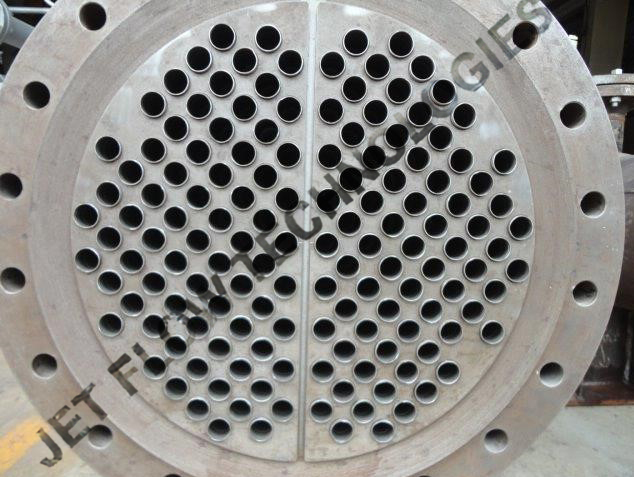
Design and Manufacturing consideration during Manufacturing of Heat Exchanger
- Tube to Tube - sheet joint
Tube to Tube Sheet Joint -Tube to tube sheet joint has the single objective
of
sealing against inter leakage between tube side and shell side fluids. The type
of
tube-to-tubesheet joint to be employed is thus largely dictated
by the anticipated difficulty in providing a reliable seal. Factors which
influence
the evaluation of the difficulty of providing a reliable seal at the
tube-to-tube sheet
joint include the following
Tube to Tube Sheet Joint
- Leak characteristics of either the tube side or shell side fluids. hydrogen and Dowthern 'A, are typical of two fluids with high leak characteristics.
- Differential pressure across the tube-to-tube sheet joint.
- Operating temperature to which the tube-to-tube sheet joint will be subjected.
- Relative hazard of inter leakage between the tube side and shell side fluids.
- Frequency and magnitude of cyclic service to which the tube to tube sheet joint will be subjected.
- Corrosion characteristics and erosive tendency of the tube side fluid.
- The metallurgy of the tube and tube sheets.
- Industry preference such as utility, refinery, chemical, petrochemical etc.
- Differential pressure stress as determined by the difference in operating pressure between tube side and shell side fluids.
- Axial stresses which may be the result of tension or compression of the tubes. Differential thermal expansion between shell and tubes or between tube passes will develop the axial stress. Similarly tube side pressure will tend to pull the tubes out of tube shell.
- Differential diametric thermal expansion between the tubes and tube sheet.
- Differential axial thermal expansion between the tube and the tube sheet with certain tube to tube sheet joint construction.
- The above briefly summerises factors which influence the selection of a tube to tube sheet joint and stress to which such joint is subjected. The tube to tube sheet joint should be tight against leakage and should have mechanical strength to resist tubes being pulled or pushed out of a tube sheet.
Electrical Tube Expander -
- Uniform Expansion
- Maximum safe guard to Tube Sheet result to no increase in Diameter or distortion of plate
- Reduced corrosion hazards
- Tube elongation reduced to minimum
- Improved quality of expansion process.
Why Choose Jet Flow Technologies
Proven Industry Experience
Broad experience in designing and manufacturing shell and tube heat exchangers for power, chemical, and process industries
Customized Engineering Solutions
Personalized designs based on your process needs, including material choice, pressure ratings, and thermal performance
Global Delivery Capability
Trustworthy supply to global markets with compliance to ASME, TEMA, PED, and other global standards
Industries We Serve
Petrochemical
Heat transfer solutions for refining, distillation, and hydrocarbon processing applications
Chemical Processing
Reliable performance in reactors, condensers, and process heating systems
Power Generation
Used in boilers, condensers, and feedwater heating systems for thermal power plants
Pharmaceutical
Precision temperature control for sensitive production and processing environments
Food & Beverage
Hygienic heat exchange systems for processing, pasteurization, and cooling
HVAC Systems
Efficient thermal management for heating, ventilation, and air conditioning applications
Marine & Offshore
Durable designs for harsh environments, including shipboard and offshore operations
Areas We Serve
India
Core design, engineering, and manufacturing hub supporting domestic and international projects
Europe
Supply and engineering support across key markets with compliance to regional pressure vessel standards
Brazil
Manufacturing and project execution capabilities for process and power sector requirements
Indonesia
Strategic production and supply support for Southeast Asian industrial applications
Global Markets
Serving clients across power generation and process industries worldwide with export-ready solutions.
FAQ
What is a shell and tube heat exchanger?
A shell and tube heat exchanger is a device with a bundle of tubes enclosed in a cylindrical shell. One fluid flows through the tubes and another flows around them through the shell, transferring heat between the two without mixing. Jet Flow Technologies manufactures these units for a wide range of industrial applications.
What is the difference between a shell and tube heat exchanger and a plate heat exchanger?
Shell and tube heat exchangers handle higher pressures, temperatures, and larger flow volumes, making them better suited to heavy industrial applications, while plate heat exchangers are more compact and efficient for lower-pressure duties. Jet Flow Technologies specializes in the former for demanding process industry needs.
What materials does Jet Flow Technologies use to manufacture shell and tube heat exchangers?
Jet Flow Technologies uses stainless steel, carbon steel, alloy steel, ADM-brass, graphite, and other exotic alloys, selected based on the fluid, pressure, and temperature involved in your process.
What industries does Jet Flow Technologies serve with its shell and tube heat exchangers?
Jet Flow Technologies supplies heat exchangers to the petrochemical, chemical processing, power generation, pharmaceutical, food & beverage, HVAC, and marine/offshore industries.
What is the maximum surface area and pressure rating Jet Flow Technologies can manufacture?
Jet Flow Technologies manufactures shell and tube heat exchangers up to 2750 m² surface area, with tube sheet thickness up to 150mm, built to ASME Section VIII, TEMA, and other global codes.
Which design standards does Jet Flow Technologies comply with?
Jet Flow Technologies designs and fabricates heat exchangers per ASME Section VIII (with/without "U" stamp), TEMA, ISS 4503, ISS 2825, HEI, PED, and AD MERKBLATTER - covering compliance requirements across the US, EU, Germany, and beyond.
Can Jet Flow Technologies customize shell and tube heat exchangers for specific applications?
Yes - Jet Flow Technologies tailors tube configuration, material of construction, tube sheet thickness, and design type (fixed, floating head, U-tube, etc.) to your exact process conditions.
How do I choose between a fixed tube sheet, floating head, and U-tube design?
Fixed tube sheet suits low temperature differentials and budget-conscious projects; floating head suits high differential temperatures needing bundle removal for cleaning; U-tube offers compact design with fewer joints. Jet Flow Technologies' engineering team can help you select the right configuration for your process.
Does Jet Flow Technologies supply shell and tube heat exchangers internationally?
Yes, Jet Flow Technologies supplies to Europe (Germany, Spain, France, Italy, UK), the Middle East, Southeast Asia (Singapore, Indonesia, Malaysia, Thailand), and other global markets, in compliance with relevant regional pressure vessel codes.
What is the lead time for a custom shell and tube heat exchanger from Jet Flow Technologies?
Lead time varies by size, materials, and design complexity - contact Jet Flow Technologies' sales team with your specifications for a project-specific timeline.