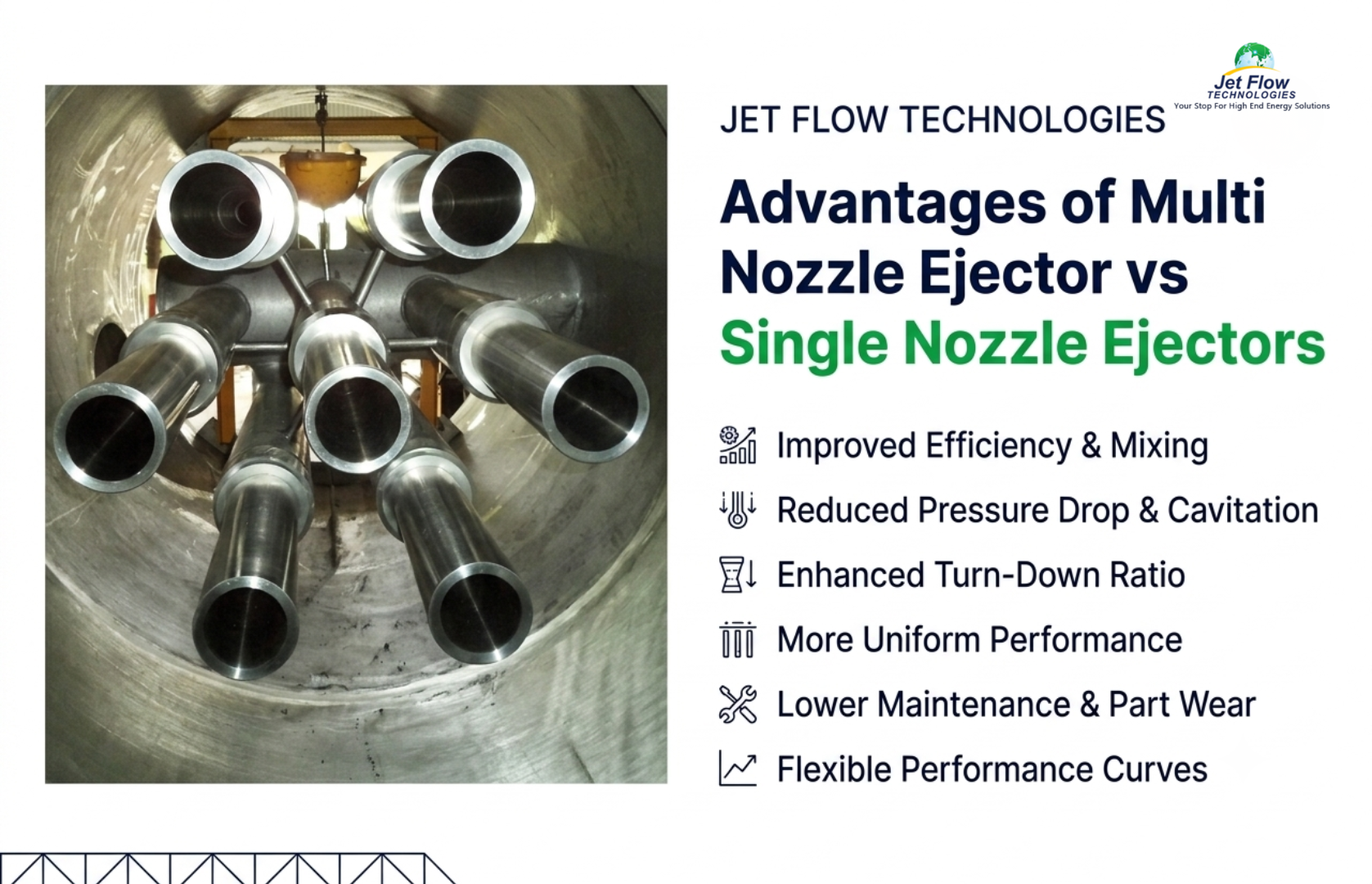
In the industries where vacuum creation, steam recovery, and efficiency play a direct role in the cost of production, it is very essential that the ejector design is given due consideration. Multi Nozzle Ejector has many operational benefits when compared with Single Nozzle Ejectors, especially for applications where there are variations in process load and steam supply.
However, many industries run their plant operations using the traditional ejectors that work well only under constant conditions. Nevertheless, in the present time, there are certain needs for more flexible and efficient equipment. It is possible to get these benefits with the help of multi nozzles technology.
A multi-nozzle arrangement could assist in improving performance as well as reducing steam usage and cost in any of the applications, including the Steam Jet Ejector, Steam Jet Air Ejector, Steam Jet Thermocompressor, and complicated single-stage and multi-stage Ejectors. Being one of the most respected manufacturers of steam jet vacuum systems, Jet Flow Technologies has noticed an increasing need for multi-nozzle designs from the industrial sector.
Understanding How Ejectors Work
Ejectors utilize high-pressure motive steam in order to carry and compress a lower-pressure gas, vapor, or air stream. Pressure energy is converted to velocity and vice versa through a diffuser stage.
The basic components include:
- Motive steam nozzle
- Suction chamber
- Mixing section
- Diffuser
In the case of the typical single-nozzle ejector, the motive steam flows through a single nozzle. The Multi Nozzle Ejector, however, utilizes several strategically designed nozzles for the distribution of motive steam. This difference may seem small on paper, but in real industrial applications, it can have a substantial impact on energy consumption and process stability.
All the ejectors in Jet Flow Technologies are custom-made considering the factors of steam pressure, suction, load, and vacuum requirements. This industry-specific design methodology enables industries to reach their maximum efficiency level rather than adopting a generic design from the catalogues.
The Problem with Traditional Single Nozzle Ejectors
Single-nozzle ejectors are typically designed around a particular operating point.
When actual plant conditions move away from the design point, several issues can arise:
- Reduced vacuum performance
- Higher steam consumption
- Process instability
- Lower entrainment efficiency
- Increased operating costs
This challenge becomes particularly visible in industries such as:
- Refineries
- Petrochemical plants
- Fertilizer plants
- Power stations
- Sugar mills
- Edible oil processing plants
- Pulp and paper manufacturing
These facilities rarely operate under perfectly constant process conditions throughout the year.
What Makes a Multi Nozzle Ejector Different?
A Multi Nozzle Ejector uses several motive steam nozzles strategically positioned inside the ejector body.
Instead of creating a single high-velocity steam jet, several optimized jets work together to:
- Increase entrainment efficiency
- Improve mixing characteristics
- Maintain vacuum stability
- Handle wider load variations
- Reduce motive steam wastage
The outcome is a more flexible ejector capable of delivering consistent performance under changing operating conditions.
According to the engineers from Jet Flow Technologies, the wider range is one of the most important factors which makes industrialists select multi nozzles technology in their facilities.
Key Advantages of Multi Nozzle Ejectors
- Better Performance Under Variable Load Conditions
One of the largest limitations of conventional ejectors is their sensitivity to process fluctuations.
Contemporary plants often experience:
- Seasonal production changes
- Variable feed quality
- Frequent load adjustments
- Startup and shutdown cycles
A Multi Nozzle and Variable Flow Ejector can adapt more effectively to these changing conditions.
Because steam flow is distributed across multiple nozzles, the ejector maintains efficient entrainment over a broader operating range.
The multi-nozzle ejector design at Jet Flow Technologies is based on actual field conditions and not the perfect lab conditions. This is because it is easier for the client to perform effectively throughout the year without being dependent on certain process parameter variations.
- Improved Steam Economy
The usage of steam is considered to be one of the most important utilities within industries. Even little cuts in steam usage result in huge savings annually. The multi-nozzle system helps in improving the efficiency of energy exchange from motive steam to suction fluid, hence helping the ejector reach the desired level of vacuum using lesser amounts of steam than other conventional single nozzle systems.
- Higher Entrainment Efficiency
Entrainment ratio is one of the most important performance indicators for any ejector.
A higher entrainment ratio means:
- Better utilization of motive steam
- Lower energy consumption
- Improved overall system efficiency
The multiple steam jets produce inside a Multi Nozzle Ejectors create a more uniform mixing profile, resulting in increased entrainment performance compared with a single nozzle arrangement.
In case of continuous industrial processes, a slight increase in efficiency of the entrainment can yield substantial cost savings for the year. One of the reasons why Jet Flow Technologies suggests using multiple nozzles is because of their efficiency.
- Greater Operational Stability
Industrial processes do not appreciate instability.
Vacuum fluctuations can affect:
- Distillation columns
- Evaporators
- Drying systems
- Crystallizers
- Condensers
A multi nozzle configuration helps maintain stable operating conditions even when suction loads fluctuate.
This stability often improves product quality and process consistency.
- Enhanced Reliability
A frequently overlooked benefit of multi nozzle systems is operational resilience.
In large process plants, reliability is often more important than achieving the absolute highest efficiency.
Since there are many nozzles through which the flow can be distributed, performance loss because of the wear or fouling of the nozzles will not be very significant, as opposed to the case when there is only one nozzle ejector.
Multi Nozzle Ejectors in Multi Stage Vacuum Systems
The benefits become even more significant when applied to Single and Multi Stage Ejectors.
Modern vacuum systems often require:
- Two-stage ejectors
- Three-stage ejectors
- Four Stage Steam Jet Ejector systems
- Five & Six Stage Steam Jet Ejector systems
As the vacuum depth increases, efficiency becomes an increasingly important consideration.
According to industrial experience, any improvement in the first stage has implications for the performance of all the stages that follow.
A multi nozzle design for the first stage may enhance the overall efficiency of the vacuum system. The multi stage steam ejector system is commonly employed to create high vacuums which cannot be attained through a single-stage ejector system.
Multi Nozzle Technology in Steam Jet Air Ejectors
A Steam Jet Air Ejector is commonly used for condenser air evacuation and vacuum maintenance applications in power plants.
These systems must continuously handle varying air leakage rates while maintaining stable vacuum levels.
A multi nozzle arrangement helps:
- Improve air handling capability
- Increase vacuum stability
- Reduce steam consumption
- Improve condenser efficiency
For power plants operating around the clock, these benefits can have a measurable impact on turbine performance and overall plant efficiency.
Multi Nozzle Ejectors in Steam Jet Thermocompressors
There are other advantages besides those related to vacuum pumps. The Steam Jet Thermocompressor compresses low-pressure steam using high-pressure steam. There are several reasons why thermocompressors are so popular – first of all, they are used to recover energy which would otherwise go to waste, and they are also easy to construct.
When multi nozzle technology is incorporated into thermocompressors, users often benefit from:
- Better compression efficiency
- Improved steam recovery
- Wider operating range
- Lower motive steam requirements
For energy-intensive industries, these improvements can contribute directly to lower fuel consumption and reduced carbon emissions.
Original Engineering Insight: The Hidden Cost of Oversized Ejectors
One issue frequently encountered in industrial facilities is ejector oversizing.
Many plants intentionally oversize single nozzle ejectors to prepare for future capacity expansion or unexpected operating conditions.
While this approach appears safe, it often creates hidden inefficiencies:
- Excess steam consumption
- Reduced efficiency at partial load
- Increased operating costs
A well-designed Multi Nozzle and Variable Flow Ejector offers a better option.
The ejector will not only operate efficiently over a wide range of loads but will also avoid the energy loss incurred by oversized single nozzles.
In several retrofit installations, this operational advantage is one of the most powerful economic reasons to upgrade to the multi nozzle configuration.
Which Industries Benefit Most?
Multi nozzle technology delivers exceptional value in:
- Power generation
- Oil and gas processing
- Refineries
- Chemical manufacturing
- Petrochemical plants
- Fertilizer production
- Food processing
- Edible oil plants
- Pulp and paper mills
- Distillation and evaporation systems
These industries frequently operate under varying loads where flexibility and steam economy are critical.
Choosing the Right Multi Nozzle Ejector
Selecting the right ejector involves more than simply choosing the number of nozzles.
Engineers should evaluate:
- Required vacuum level
- Steam availability
- Process variations
- Suction load characteristics
- Future expansion plans
- Energy consumption targets
The most successful installations are typically based on application-specific engineering rather than standard catalog selections. The efficiency of the Multi Nozzle Ejector is highly influenced by how well it has been engineered. At Jet Flow Technologies, we design ejector systems based on the study of process conditions, steam properties, suction requirements, and vacuum requirements.
Final Thoughts
The discussion surrounding the selection of single-nozzle vs multi nozzle ejectors has transcended into much more than just a vacuum discussion. With current day industrial requirements that focus on energy savings and process reliability, there is another aspect that needs to be considered and that is operational flexibility.
This is where a Multi Nozzle Ejector can offer some distinct advantages in all three areas. No matter whether these systems are Steam Jet Ejectors, Steam Jet Air Ejectors, Steam Jet Thermocompressors, Four Stage Steam Jet Ejectors or even cutting-edge Five & Six Stage Steam Jet Ejector systems, it is becoming harder and harder to overlook the advantages.
Facilities looking for efficiency improvements and potential long term cost reductions should definitely consider investing in a state-of-the-art multi-nozzle ejector system.