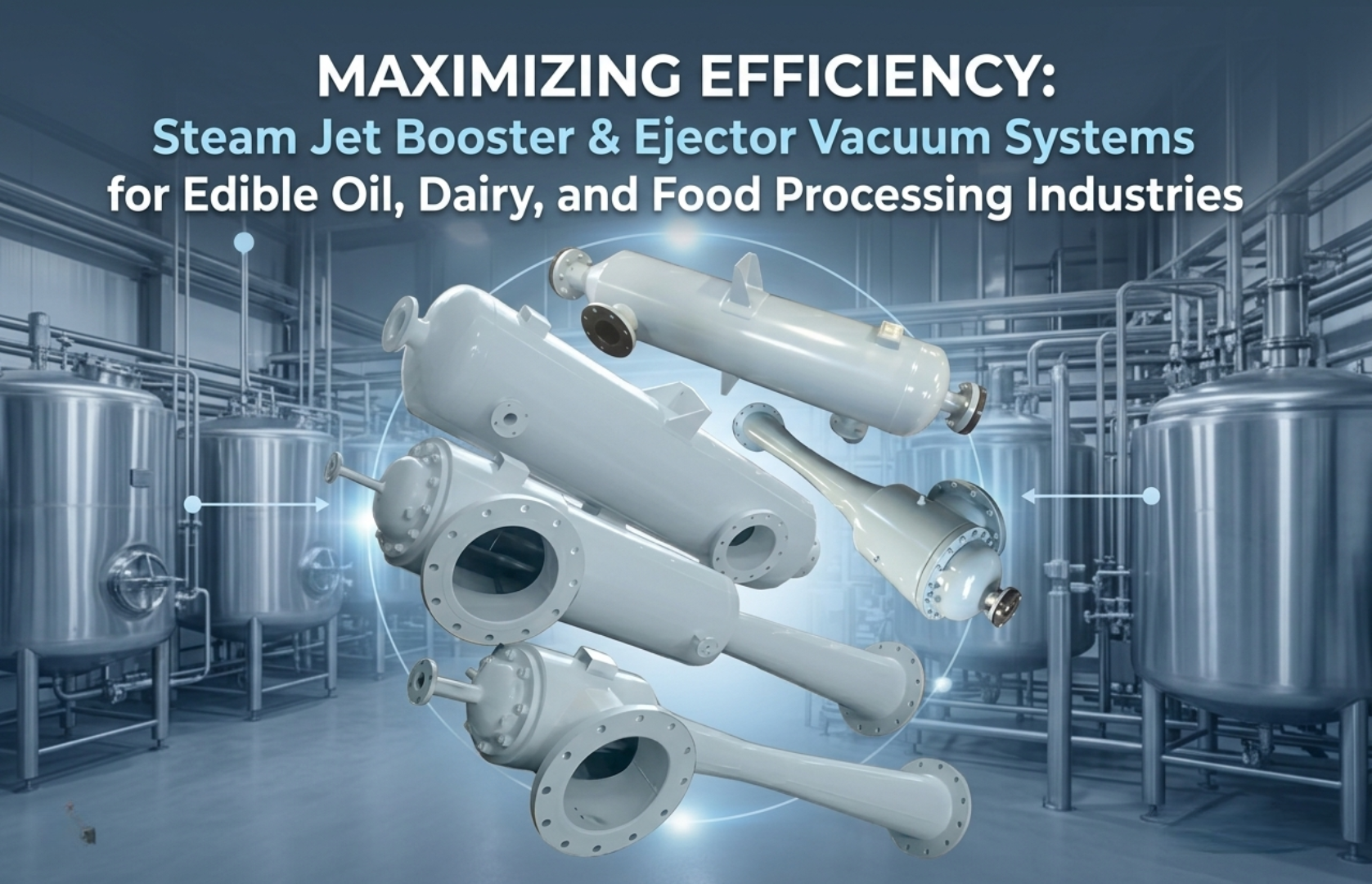
In edible oil refineries, dairy plants, and food processing plants, the importance of maintaining a proper vacuum pressure cannot be overstressed. Vacuum has an impact on the quality of the product being produced, moisture evaporation, cooling, and efficiency. A poorly designed vacuum system will affect power consumption and efficiency.
This is where a properly engineered Steam Jet Ejector system becomes important.
The use of steam-driven vacuum pumps by industries for many years has been attributed to their ease of use, durability, and ability to operate under difficult conditions. In comparison with mechanical pumps whose components move, the working of steam ejectors uses motive steam in generating a vacuum due to a pressure difference.
At Jet Flow Technologies, industrial vacuum systems are designed specifically for continuous process industries where reliability and process stability are essential.
Understanding the Heart of the System: How It Works
Before looking at particular industry implementations, it helps to understand why this technology is incredibly consistent. A steam jet vacuum ejector operates on a deceptively simple thermodynamic principle: the Venturi effect.
- High-pressure motive steam enters the ejector and passes through an engineered convergent-divergent nozzle.
- As the steam expands, its pressure energy drops sharply, converting into ultra-high velocity.
- This drop forms a strong vacuum in the suction chamber, drawing in the process gases or vapors.
- The mutual stream enters the diffuser, where the velocity slows down, converting back into static pressure to smoothly discharge the mixture.
As a steam-driven ejector has zero moving parts, there are no bearings to seize, no seals to leak, and no mechanical components to wear out over time. It is pure, dependable physics at work.
Critical Applications in Food, Dairy, and Edible Oil Processing
A standardized, one-size-fits-all vacuum pump rarely cuts it in hygienic processing. Different products require different levels of vacuum depth and handling capabilities.
- Edible Oil Refining (Deodorization & Bleaching)
Vacuum extraction for edible oil production requires a high degree of vacuum since the aim is to remove volatile organic compounds, free fatty acids, and undesirable odors from the oil without damaging the oil. A Steam Jet Ejector vacuum system for edible oil plant can be used for this purpose, because this can streamline the process. With the help of the vacuum boosting system in combination with the subsequent stages, the vacuum required is generated at the specified fractions of millibars needed for top-notch quality oil. Besides, the process will not cause any carryover vapors due to fatty acids, thus avoiding tedious clean-outs of liquid ring pumps.
- Dairy Processing (Evaporation & Concentration)
When it comes to the production of milk and whey powder, thermal degradation should be your major concern. To obtain a concentrate from dairy liquids without changing their taste or denaturing proteins contained therein, you need to reduce the boiling temperature of water.
This can be achieved via a vacuum steam ejector that enables low-temperature evaporation. For optimal use of energy, the most modern dairy processing units tend to use a steam jet thermocompressor ejector which uses exhaust steam from an evaporator together with motive steam.
- Food Processing & Flash Cooling
From vacuum packaging to flash cooling baked goods or cooked sauces, a steam vacuum ejector system provides rapid pull-down times. When hot food products need to be cooled quickly to prevent bacterial growth, these systems handle large volumes of flash steam seamlessly.
Importance of Vacuum Systems in Dairy Processing
Dairy processing plants relies heavily on controlled vacuum settings. During milk evaporation, condensation, and drying operations, vacuum helps decreasing boiling temperatures and preserve product quality.
A well-designed steam jet ejector vacuum system improves:
- Product consistency
- Energy efficiency
- Moisture control
- Hygienic processing conditions
Applications in dairy industries include:
- Milk evaporation systems
- Spray dryers
- Vacuum pans
- Condensers
- Sterilization units
Since these plants run round the clock, reliability assumes precedence over everything else. Mechanical malfunctions may stall the whole process and even cause loss of goods. That is why a lot of large companies still favor a dependable steam-driven ejector system over conventional pump.
Food Processing Industry Requirements
Food processing environments demand equipment that can withstand moisture, vapor loads, temperature fluctuations, and continuous production cycles.
A reliable ejector vacuum system helps processors maintain:
- Stable vacuum levels
- Better product texture
- Faster drying cycles
- Improved thermal efficiency
- Reduced contamination risk
Food industries commonly use steam ejector vacuum pump systems for:
- Vacuum concentration
- Vacuum cooling
- Freeze drying
- Distillation
- Packaging processes
Since food-grade operations require dependable performance, the quality of design and fabrication plays a major role in system life and operating cost.
Choosing the Right Configuration: Single-Stage vs. Multi-Stage Systems
Depending on your facility’s specific temperature targets and pressure requirements, your ideal jet ejector vacuum system will fall into one of a few configurations:
| System Type | Vacuum Range | Best Suited For | Key Benefit |
| Single-stage steam ejector | Modest vacuum (down to ~30 mbar) | Light venting, priming, simple flash cooling | Low initial cost, compact footprint |
| Multi-stage steam ejector | Deep vacuum (below 1 mbar) | Edible oil deodorization, deep concentration | Reaches ultra-low absolute pressures |
| Ejector and condenser package | Deep vacuum with vapor management | Continuous process lines with high condensable vapor loads | Knocks out steam/vapors to reduce down-stream load |
In multi-stage systems, the steam ejector condenser is fitted between the stages. The condensing of the process vapors, which are easy to manage, to water leads to a great reduction in the amount of gas that needs to be compressed by the next stage of the process.
Why Savvy Plant Managers Are Replacing Mechanical Pumps
For years, the steam ejector vacuum pump has been the quiet workhorse of heavy industry. When compared head-to-head with mechanical liquid ring or dry vacuum pumps in a food-grade environment, the advantages are clear:
- Zero Contamination Risks: Mechanical pumps require internal lubricants that risk contaminating your food product or process streams. A steam-operated ejector uses only steam, aligning perfectly with strict food safety and HACCP standards.
- Unmatched Reliability: Mechanical pumps struggle with slugging liquids or particulate carryover. A vacuum generation system driven by steam swallows condensable vapours, corrosive gases, and minor liquid carryovers without a stutter.
- Effective Non-Condensable Gas Removal: In any vacuum system, air leaks and non-condensable gases inevitably creep in. Your system must be capable of continuous non-condensable gas removal to prevent vacuum decay. Steam ejectors excel at sweeping these gases out of the process loop consistently.
Maximizing Your ROI with Jet Flow Technologies
Investing in an ejector vacuum system isn’t just about buying hardware; it is about optimizing your utility balance. To ensure you get the absolute highest return on investment, our engineering team looks at your entire plant ecosystem:
- Motive Steam Availability: We design your motive steam ejector to match your existing boiler pressures so you don’t have to install expensive pressure-regulating overhauls.
- Cooling Water Temperatures: Because condenser performance is bound to water temperatures, we customize the internal geometry to fit your local climate and cooling tower capacities.
- Material Construction: For food and dairy applications, we utilize high-grade, polished stainless steel to comply with sanitization protocols and prevent corrosion.
Why Industries Prefer Steam Jet Ejectors
Despite advancements in mechanical vacuum technologies, industries still trust industrial steam ejectors for critical operations.
Key Reasons Include:
Simple Construction: No moving components means fewer mechanical failures.
Low Maintenance: Maintenance requirements remain minimal compared to rotary vacuum pumps.
Long Operational Life: Industrial-grade systems can perform reliably for decades with proper design.
Suitable for Harsh Conditions: Steam ejectors handle corrosive gases, moisture, and vapor mixtures effectively.
Continuous Operation: Ideal for 24/7 industrial production environments.
Cost-Effective Performance: A properly designed vacuum generation system reduces downtime and operating costs over time.
Let’s Optimize Your Production Line
A properly designed Steam Jet Ejector system plays a critical role in edible oil refining, dairy processing, and food manufacturing operations. From maintaining product quality to improving energy efficiency, industrial vacuum systems directly affect plant productivity and operating costs.
Whether you need a compact steam-operated ejector or a complete single and multi-stage steam Jet ejector arrangement with condensers, choosing the right engineering partner makes a major difference.
For industries looking for dependable vacuum performance, long service life, and process-specific engineering, Jet Flow Technologies delivers practical and efficient solutions built for continuous industrial operation.