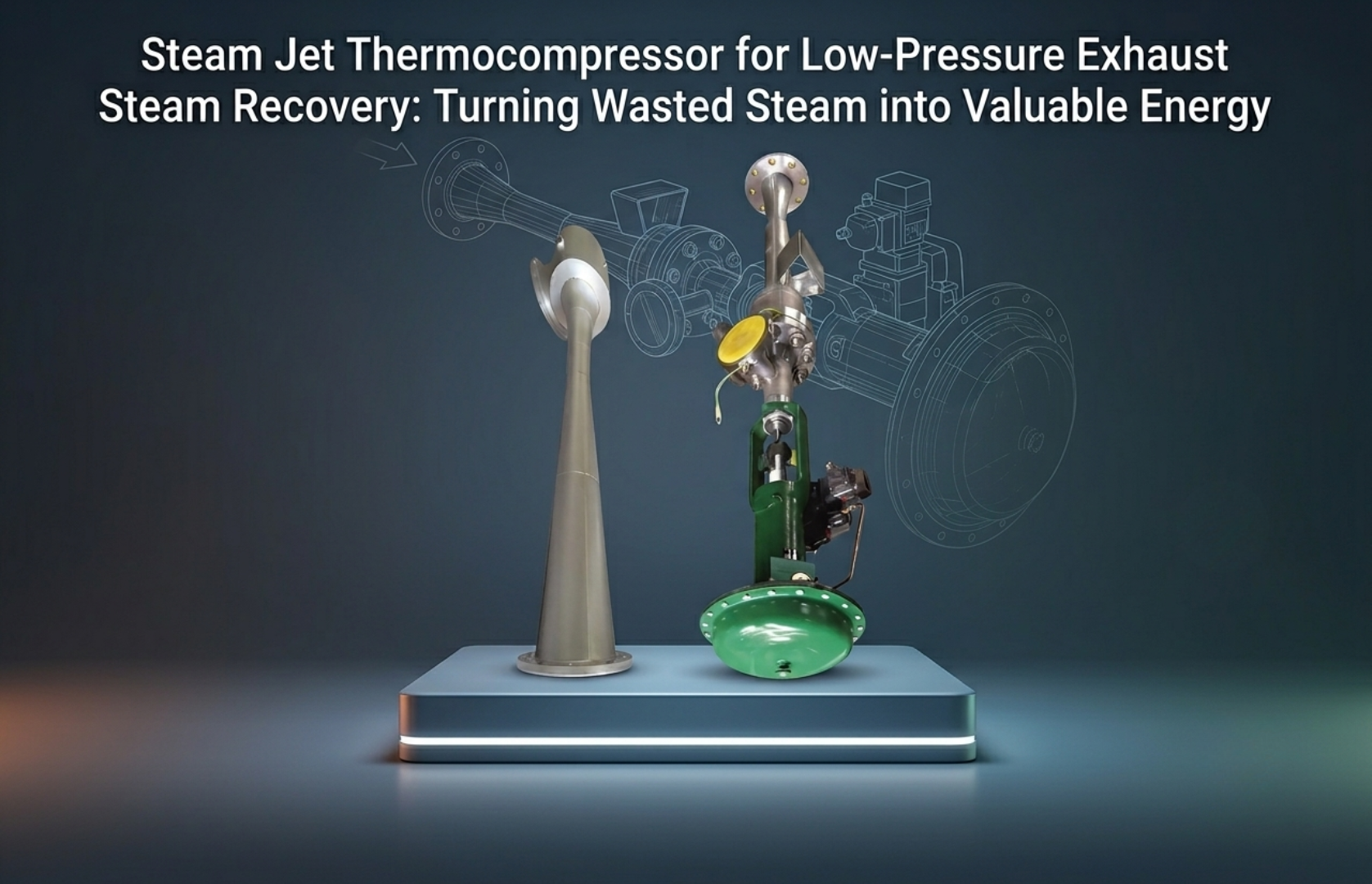
In many factories, steam drains a fortune from the wallet. However, lots of low-pressure exhaust steam goes unused each day – released into the air or condensers. This wasteful practice means missed chances for plant owners and purchasing managers aiming to cut costs.
The application of a well-designed Steam Jet Ejector as a thermocompressor turns low-pressure exhaust steam into a valuable energy source. Industries can take advantage of the usable steam energy in a wide range of process applications and reuse it instead of losing it to the atmosphere. This improves efficiency and cuts fuel consumption.
At Jet Flow Technologies, we work with industries looking for real solutions to optimize steam. A top method? Using a Thermocompressor Ejector System to recover low-pressure exhaust steam. So, it’s a win for efficiency and cost-saving, too.
Understanding Low-Pressure Exhaust Steam
Many industrial operations generate exhaust steam as a by-product. Common examples include:
- Evaporation systems
- Drying processes
- Distillation units
- Turbine exhaust systems
- Chemical processing plants
- Food and beverage manufacturing facilities
- Textile processing operations
The issue is that this exhaust steam typically exists at a pressure too low for direct reuse. So, valuable thermal energy stays trapped and can’t be used effectively without pressure enhancement. That’s where a Steam Jet Ejector comes in; it’s the ideal solution for the job.
What Is a Steam Jet Thermocompressor?
A steam jet thermocompressor is a specialized form of Steam Ejector System that uses high-pressure motive steam to entrain and compress low-pressure exhaust steam.
The process is straightforward:
- High-pressure steam enters the ejector nozzle.
- The steam accelerates to high velocity.
- This creates a low-pressure zone.
- Low-pressure exhaust steam is drawn into the ejector.
- Both steam streams mix efficiently.
- The mixed steam exits at an intermediate pressure suitable for reuse.
The result is a practical method of upgrading otherwise wasted steam energy.
Unlike mechanical compressors, steam jet thermocompressors contain no moving parts, making them highly reliable and suitable for demanding industrial environments.
Why Industries Are Adopting Steam Jet Ejectors for Steam Recovery
Energy costs continue to rise across industries. Manufacturers are constantly searching for ways to improve efficiency without major capital investments. A properly engineered Steam Jet Ejector offers several advantages:
Reduced Steam Consumption: By recovering and reusing low-pressure exhaust steam, facilities require less fresh boiler steam. This directly lowers fuel usage and operating expenses.
Improved Energy Efficiency: Instead of venting usable thermal energy, thermocompressors recycle it back into the production process.
Minimal Maintenance: Unlike mechanical compression systems, steam ejectors have no rotating equipment. Fewer components mean fewer maintenance concerns.
Long Service Life: Industrial-grade ejectors are known for dependable operation even under challenging process conditions.
Quick Return on Investment: Many facilities experience measurable energy savings shortly after installation, making steam recovery projects financially attractive.
How Steam Jet Ejectors Compare to Mechanical Compression Systems
When evaluating steam recovery technologies, purchasers often compare thermocompressors with mechanical compressors.
Mechanical systems typically involve:
- Motors
- Bearings
- Rotating elements
- Lubrication systems
- Electrical infrastructure
A Steam Jet Ejector, on the other hand, operates using steam energy alone.
This results in:
- Lower maintenance requirements
- Simpler installation
- Higher reliability
- Reduced downtime
- Lower lifecycle costs
For many industries, these advantages make thermocompressors the preferred option.
Applications of Steam Jet Thermocompressors
Steam recovery opportunities exist across numerous sectors.
Chemical Processing: Chemical plants frequently use steam for heating, evaporation, and distillation. Recovered steam can be redirected into multiple process areas.
Pharmaceutical Manufacturing: Precise thermal control is essential in pharmaceutical production. Steam recovery helps improve efficiency while maintaining process stability.
Food Processing: Food manufacturers utilize steam extensively for cooking, sterilization, and drying operations. Recovering exhaust steam can significantly reduce utility costs.
Pulp and Paper Industry: Large quantities of steam are consumed throughout paper production. Thermocompressors improve energy utilization across the facility.
Textile Manufacturing: Steam plays a major role in dyeing, finishing, and drying processes. Recovery systems help lower operational expenses.
These industries often integrate steam recovery solutions alongside Industrial Vacuum Systems and other process optimization technologies.
The Role of Steam-Driven Vacuum Technology
Steam recovery and vacuum generation frequently work together in process industries.
Many facilities use Steam-Driven Vacuum Technology for:
- Distillation
- Evaporation
- Degassing
- Drying
- Chemical reactions
In such environments, the same engineering expertise used for steam recovery also applies to vacuum systems.
A comprehensive approach often combines:
- Steam recovery equipment
- Vacuum Generation Equipment
- Process condensers
- Ejector systems
This integrated design maximizes plant efficiency.
Steam Jet Ejectors in Vacuum Applications
While thermocompressors focus on steam recovery, ejector technology also supports a wide range of Process Vacuum Applications.
Industries commonly employ:
Ejector Vacuum Pump Systems
An Ejector Vacuum Pump uses steam as the motive force to create vacuum conditions without moving parts.
These systems are valued for:
- Reliability
- Low maintenance
- Ability to handle corrosive gases
- High-temperature operation
Multi-Stage Steam Ejector Systems
For deeper vacuum requirements, facilities often install a single and multi-Stage Steam Ejector configuration.
Multiple stages allow the system to progressively reduce pressure while maintaining stable operation.
Applications include:
- Vacuum distillation
- Solvent recovery
- Petrochemical processing
- Chemical manufacturing
High Vacuum Steam Ejector Solutions
Where extremely low pressures are required, five & six stage steam jet ejectors that are high Vacuum Steam Ejector, provides dependable performance.
These systems are widely used in demanding industrial processes where mechanical vacuum pumps may struggle.
Importance of Condenser and Ejector Assembly Design
Performance depends heavily on proper system design.
A well-engineered Condenser and Ejector Assembly improve:
- Steam utilization
- Vacuum efficiency
- Operating stability
- Utility consumption
Poorly designed assemblies can increase steam usage and reduce overall system performance.
This is why engineering expertise is critical when selecting a supplier.
At Jet Flow Technologies, every system is designed according to actual process conditions rather than generic specifications.
Factors to Consider Before Purchasing a Steam Jet Ejector
Purchasers should evaluate several factors before investing in a steam recovery system.
Steam Pressure Conditions: Understanding available motive steam pressure is essential.
Exhaust Steam Characteristics: Temperature, pressure, and flow rate determine ejector sizing requirements.
Desired Outlet Pressure: The target pressure influences thermocompressor design and performance.
Future Capacity Requirements: Selecting equipment with future expansion capability can prevent costly upgrades later.
Supplier Experience: Steam recovery projects require specialized engineering knowledge. Working with an experienced manufacturer helps ensure long-term success.
Why Customized Engineering Matters
Every plant operates differently.
Steam conditions, production requirements, utility costs, and process demands vary from facility to facility.
A standard product rarely delivers optimal performance.
Customized solutions provide:
- Better energy recovery
- Improved efficiency
- Reduced operating costs
- Greater reliability
This engineering-focused approach is what separates successful steam recovery projects from average installations.
Partner with Jet Flow Technologies for Efficient Steam Recovery
Recovering low-pressure exhaust steam is no longer simply an energy-saving initiative. It is a practical business decision that directly impacts profitability.
A well-designed Steam Jet Ejector turns wasted steam into a useful process resource, boosting plant efficiency. Whether you need a Steam Ejector System, a Thermocompressor Ejector System, Vacuum Generation Equipment, Industrial Vacuum Systems, or a full Condenser and Ejector Assembly, the right solution can make a big difference.
At Jet Flow Technologies, we help industries optimize steam utilization through reliable, customized ejector solutions built around real-world operating conditions.
If your facility is currently venting low-pressure steam, now is the time to explore how steam recovery can reduce costs, improve energy efficiency, and strengthen long-term operational performance.