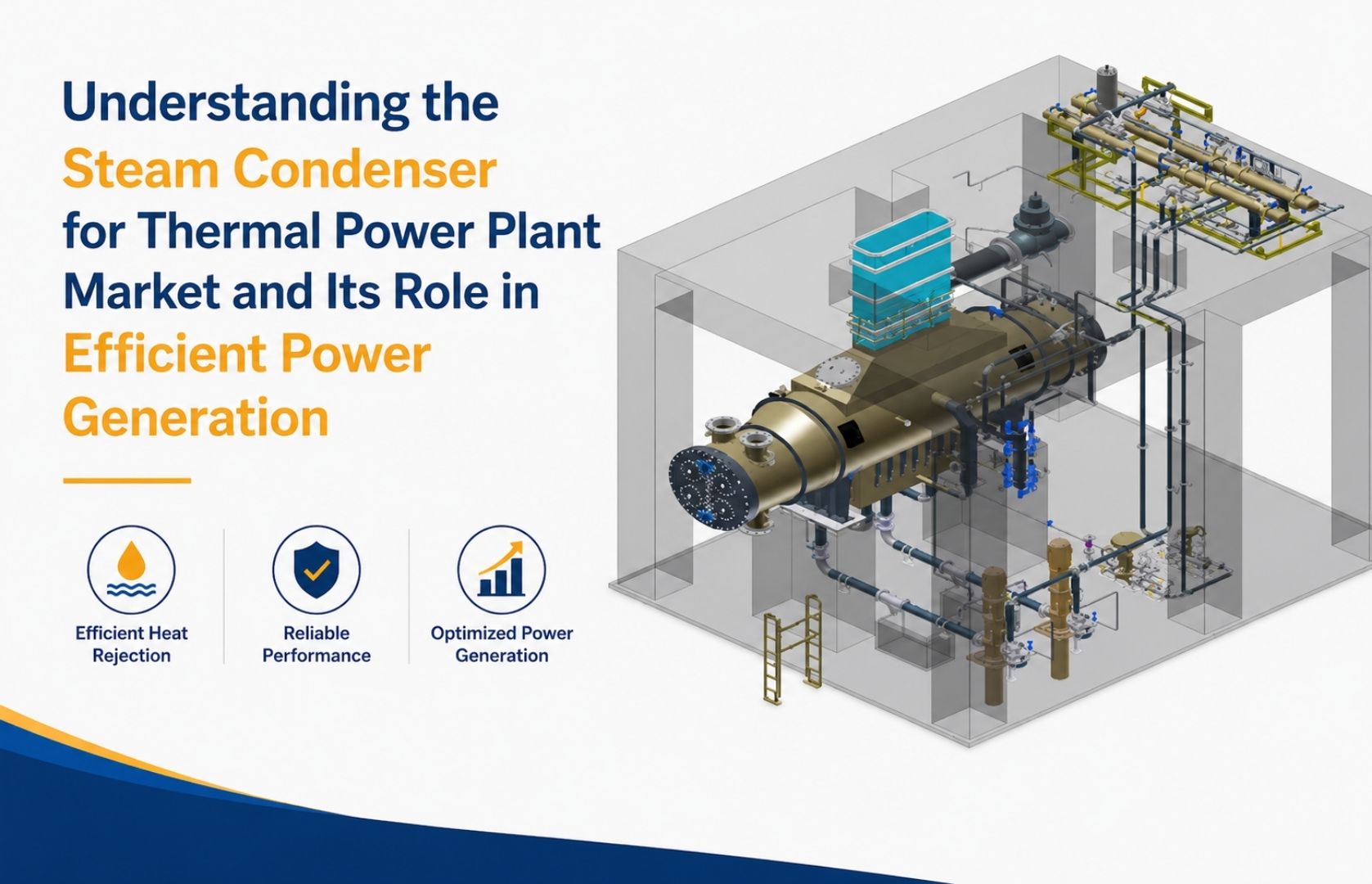
In modern industrial operations, thermal efficiency is not merely an operational goal, it is a financial necessity. Power plant operators and industrial facilities globally face continuous pressure to optimize heat rates, minimise water consumption, and lower fuel expenditures. While the steam turbine receives much of the attention in power generation, the equipment handling turbine exhaust steam is equally important. At the core of this thermodynamic balancing act sits a crucial heat exchange component: the steam condenser.
By converting turbine exhaust steam back into pure liquid condensate, this equipment establishes the low backpressure required to maximize mechanical work. Its performance directly influences turbine efficiency, heat rejection, condensate recovery, and overall steam-cycle operation. As power generation facilities focus gradually on efficient equipment and tailored engineering solutions, these requirements continue to shape the steam condenser for the thermal power plant market. Understanding how condenser systems work can help plant owners and engineers make better equipment and system-design decisions.
The Fundamental Role of a Steam Condenser in Power Generation
The steam condenser works as the heat sink for a closed Rankine cycle. Placed right after the discharge of the steam turbine, the basic function is the conversion of gaseous steam to liquid form under sub-atmospheric pressure.
The Thermodynamics of Vacuum Creation
As exhaust steam goes into the condenser shell and contacts cold heat exchanger tubes, it quickly condenses. As liquid water occupies a fraction of the volume of low-pressure steam, this sudden phase transformation creates a deep vacuum within the shell.
- Expanded Enthalpy Drop: Lowering backpressure at the turbine exhaust enhances the enthalpy drop across the turbine blades, directly growing power output without burning additional fuel.
- Feedwater Recovery: The resulting condensate is virtually free of mineral contamination. Recirculating this water back to the boiler dramatically decreases raw water consumption and chemical treatment expenses.
- Dissolved Gas Removal: Sophisticated condensing loops collect and strip non-condensable gases (, ) to shield boiler tubes and piping from oxygen pitting and aggressive corrosion.
Critical Components of an Integrated Condensing Loop
Achieving peak plant output requires precise coordination between several key thermal and mechanical systems:
- Steam Surface Condenser: The central shell-and-tube heat exchanger that converts massive exhaust steam volumes into pure condensate.
- Gland Steam Condenser: A specially designed auxiliary sub-system is designed to capture steam leaking from the turbine shaft gland seals. By compacting this high-value leakage, it improves latent heat into the boiler feedwater circuit while maintaining moist steam out of the turbine room atmosphere.
- Steam Jet Ejector: A motive steam jet air ejector unit engineered to constantly pull air and non-condensable gases out of the main shell, sustaining vacuum reliability.
- Condensate Extraction Pumps (CEP): High-reliability vertical or horizontal pumps that transfer the collected hot water from the condenser hotwell back into the feed heating loop.
What Is a Steam Gland Condenser and Why Is It Important?
A steam gland condenser is associated with the turbine gland sealing arrangement rather than serving as the primary condenser for turbine exhaust steam. Turbine shaft glands require sealing to limit unwanted air ingress, particularly around areas operating under vacuum. The gland sealing system uses steam to maintain appropriate sealing conditions. The gland vent condenser then needs to be managed effectively.
Market Dynamics: The Evolving Steam Condenser for Thermal Power Plant Market
The international steam condenser for thermal power plant market is experiencing a substantial revolution driven by severe environmental guidelines, aging infrastructure updates, and the expansion of captive power generation.
In the modern thermal power plant market, plant owners prioritize custom engineering over standard off-the-shelf units. Variable seasonal cooling water temperatures, fluctuating turbine loads, and space constraints need bespoke tube-bundle geometry, optimized pressure drop, and advanced anti-fouling designs.
Companies operating within the competitive market depend heavily on expert thermal modeling to ensure equipment can deal with sudden load surges without vacuum decay. Upgrading equipment in the thermal power plant remains one of the quickest paths to reduce heat rates and smaller carbon footprints.
Factors That Affect the Performance
Several operating and design factors can influence condenser efficiency.
- Cooling Water Temperature
Cooling-water temperature has a direct connection with the heat-transfer conditions existing in the condenser. Higher inlet temperatures can make it more complex to attain low condensing pressure.
- Cooling Water Flow Rate
The cooling system must offer enough flow for effective heat transfer. Insufficient flow can impact heat rejection and enhance condenser pressure.
- Tube Cleanliness
Deposits, fouling, and debris on condenser tubes can reduce heat-transfer effectiveness. Regular inspection and appropriate cleaning practices are therefore important for maintaining performance.
- Air Ingress
Non-condensable gases can increase condenser pressure and interfere with heat transfer. Reliable air-removal equipment is consequently an important part of a complete condensing system.
- Design and Material Selection
The operating environment should guide the selection of tubes, tube sheets, materials, and other components. Cooling-water chemistry, temperature, pressure, flow conditions, and maintenance requirements all need to be considered.
Jet Flow Technologies stated that condenser options include materials such as carbon steel, stainless steel, copper or nickel alloys, titanium, and duplex materials, with configurations selected according to application and cooling-water conditions.
Choosing the Right Steam Condenser for a Thermal Power Plant
Selecting the optimal steam condenser requirements requires balancing thermodynamic performance with site-specific constraints. As the condenser directly controls backpressure, selecting the right system is critical for maximizing the efficiency of the turbine and overall heat rate.
When evaluating options, engineering teams must consider:
- Cooling Water Quality & Metallurgy: Water chemistry dictates tube materials, ranging from carbon steel and stainless steel to titanium or duplex alloys, to prevent corrosion and biofouling.
- Plant Layout & Footprint: Compact circular configurations with axial, down-flow, or side-inlet steam entries allow smooth integration within tight space constraints.
- Load Variations & Ambient Temperatures: Condensers must handle seasonal cooling water temperature shifts and turbine overloads without vacuum decay.
- Auxiliary Integration: Ensuring compatibility with a gland steam condenser and air evacuation packages prevents efficiency losses from non-condensable gas buildup.
Partnering with Jet Flow Technologies ensures custom-engineered systems designed to HEI and ASME standards for maximum cycle efficiency.
Why Choose Jet Flow Technologies?
When evaluating performance upgrades, Jet Flow Technologies brings world-class engineering, custom design options, and proven manufacturing standards to every project.
- Precision Custom Engineering: Jet Flow Technologies designs economically sized, high-performance systems for turbine ratings under 100 MW, built in strict compliance with the latest Heat Exchange Institute (HEI) and ASME standards.
- Turnkey System Packages: Jet Flow Technologies supplies complete skids, incorporating everything from turbine-to-condenser expansion joints and steam Surface Condenser shells to Steam Jet Ejector vacuum packages and automated level control valves.
- Optimized Heat Transfer: By refining tube-nest layouts, Jet Flow Technologies ensures uniform heat loading, minimal condensate subcooling, and tremendously low oxygen concentrations in output water.
Areas We Serve
Areas We Serve
Jet Flow Technologies operates a global engineering and manufacturing network, supplying high-efficiency process equipment, surface condensers, and vacuum systems to customers across 40+ countries worldwide.
- Global Manufacturing & Design Hubs:
- Engineering Headquarters & Manufacturing: Western India
- International Manufacturing & Fabrication Facilities: Europe, Brazil, and Indonesia
- Strategic Partnership: In association with JET FLOW Technologies UK Limited
- Primary Regional Markets:
- India: Serving major industrial hubs, thermal power plants, and process industries nationwide.
- Europe & UK: Providing engineered steam solutions across the United Kingdom, Germany, France, Belgium, Spain, Italy, Greece, and Poland.
- Americas: Supplying clients across the USA, Canada, Mexico, Brazil, Argentina, and Chile.
- Southeast Asia & Asia-Pacific: Delivering solutions to industrial zones in Indonesia, Singapore, Malaysia, Philippines, China, Taiwan, Korea, Japan, and Australia.
- Middle East & Africa: Supporting power generation and processing operations in South Africa, Nigeria, Kenya, Cameroon, Egypt, Saudi Arabia, and the UAE.
- Key Industries Served Globally: Thermal power plants (conventional and cogen), steel mills, chemical and petrochemical refineries, fertilizer units, edible oil processing, food processing, bio-gas plants, and paper & pulp operations.
Key Best Practices for Maintaining Vacuum Efficiency
To maintain long-term heat transfer rates and protect plant assets, engineering teams should follow these maintenance principles:
| Operating Focus | Target Objective | Impact on Efficiency |
| Gland Leakage Control | Integrate a dedicated steam gland condenser | Captures seal steam, preventing ambient moisture build-up and recovering feedwater heat. |
| Non-Condensable Removal | Maintain continuous air venting via ejectors | Eliminates insulating air blankets on tube surfaces to maintain deep vacuum levels. |
| Water Chemistry & Cleaning | Prevent scale and biofouling inside tube bundles | Preserves high heat transfer coefficients and prevents tube wall corrosion. |
Optimize Your Thermal Power Cycle Today
Upgrading your steam cycle with an engineered condensing loop is one of the most reliable strategies for improving overall plant heat rates. Whether you are retrofitting an existing facility or planning a new installation, custom designs deliver the reliability, water efficiency, and power output your operations demand.
Explore complete equipment specifications and custom-engineered options on our target Steam Condensing System product page, or contact the technical team at Jet Flow Technologies today!
Frequently Asked Questions
1. What is the function of a steam condenser in a thermal power plant?
The steam condenser is used to change low-pressure exhaust steam from the turbine to condensate by heat transfer to a cooling fluid. In addition, the steam condenser assists in keeping a low pressure at the turbine exhaust side, which allows for more expansion of the steam in the turbine. The recovered condensate can then be returned to the feedwater cycle.
2. Why is vacuum important in a steam condenser?
Condenser vacuum helps maintain low pressure at the turbine exhaust, supporting remarkable steam expansion and efficient energy extraction. Air and other non-condensable gases can enhance condenser pressure and interfere with heat transfer, so reliable air removal is essential for maintaining condenser performance.
3. What causes loss of vacuum in a steam condenser?
Common causes include inadequate cooling-water flow, high cooling-water temperature, air leakage into the vacuum system, fouled condenser tubes, excessive hotwell level, and malfunctioning air-removal equipment such as ejectors or vacuum pumps. Identifying the specific cause quickly is important because poor vacuum can affect turbine performance.
4. What is a steam gland condenser?
A steam gland condenser is a specialized condenser used with a steam turbine’s gland sealing system. It collects and condenses steam from the turbine glands while helping maintain the required pressure conditions around the gland seals. It also supports condensate recovery and helps prevent unwanted air ingress into the turbine’s vacuum sections.
5. How does condenser tube fouling affect power plant performance?
Fouling on condenser tubes can reduce heat-transfer effectiveness, making it harder to maintain the desired condenser pressure. As condenser performance deteriorates, turbine back pressure can increase and overall plant efficiency can decline. Regular inspection and appropriate tube-cleaning practices are therefore important, particularly where cooling-water quality creates a higher fouling risk.
6. What should be considered when selecting a condenser for a thermal power plant?
Condenser selection should consider turbine exhaust steam flow and pressure, required vacuum, cooling-water temperature and quality, heat-rejection requirements, condenser materials, tube arrangement, air-removal capacity, condensate flow, available space, and maintenance requirements. A customized system should be designed around the plant’s actual operating conditions rather than relying solely on a standard condenser specification.