A Waste-to-Energy (WtE) plant generates electricity and heat from the wastes produced by industrial and municipal activities; hence, it forms a key component of sustainable waste management processes. In every high-performing WtE plant, a steam turbine plays a crucial role. However, to run effectively, the steam turbine requires maintenance of a constant vacuum in the condenser. Even a minor level of entrapped air or other non-condensable gases may cause a reduction in heat transfer rate and turbine back pressure.
This is where the function of a steam jet air ejector becomes crucial. Being a vacuum ejector system, it constantly extracts excess gases from the steam turbine condenser through motive steam of high pressure. As opposed to mechanical vacuum pumps, steam jet air ejectors have no moving parts and are highly reliable.
In this guide, you’ll learn how a Steam Jet Air Ejector works, why it is indispensable in a Waste-to-Energy plant, and how selecting the right system from an experienced manufacturer such as Jet Flow Technologies can improve operational efficiency, reliability, and long-term plant performance.
What Is a Steam Jet Air Ejector (SJAE)?
A steam jet air ejector is one of the machines that is used to create vacuum using high-pressure steam. This machine extracts air and other non-condensable gases in steam condensers and process systems without the use of any mechanical parts.
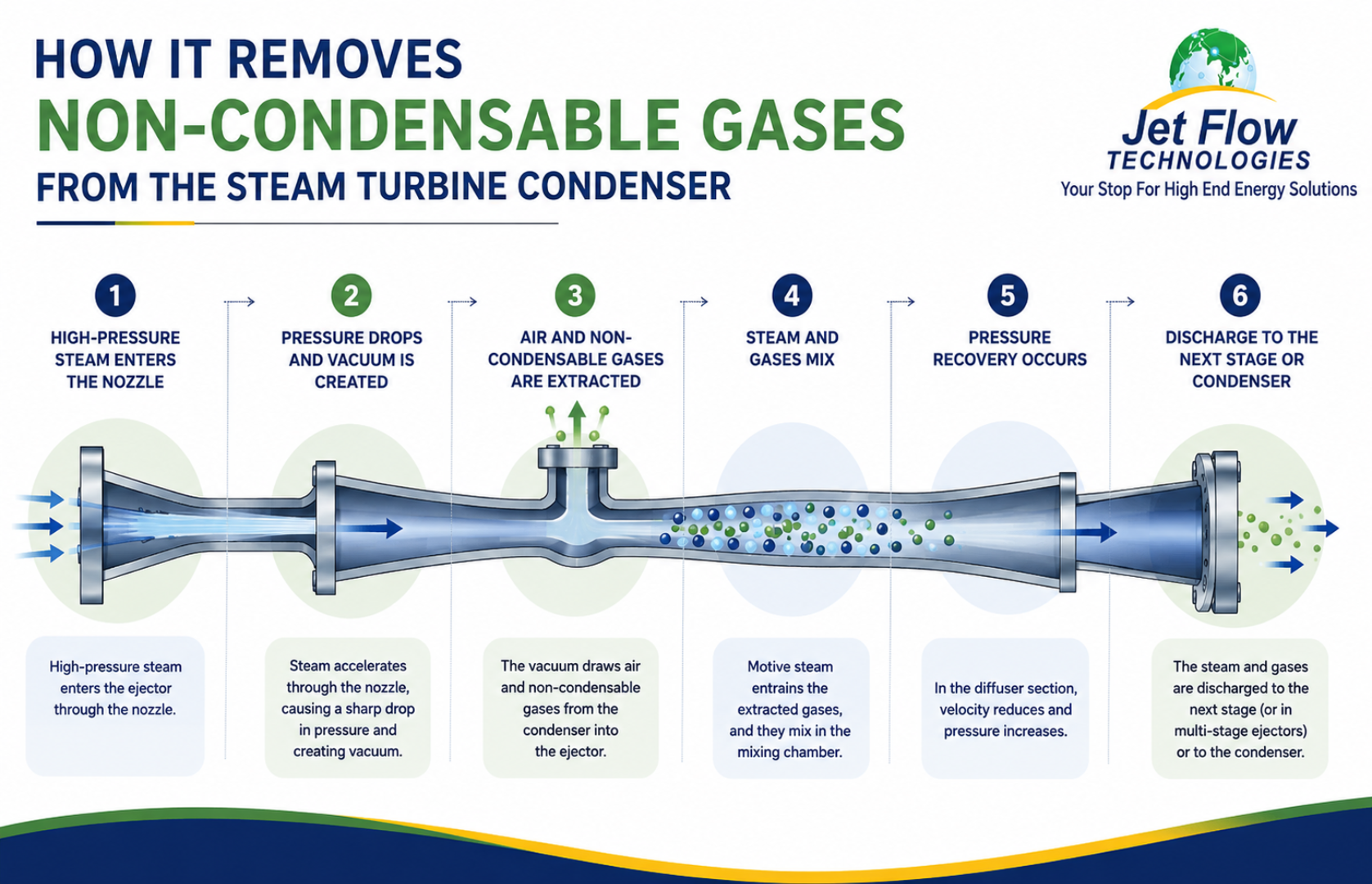
The principle of operation is based on the Venturi effect. Steam at high pressure moves in the nozzle, and the speed is increased at the cost of decreasing pressure. At the point of low pressure, there is suction of gases from the condenser to the ejector. Both steam and gases merge in the mixing chamber to move in the diffuser.
A typical steam ejector system consists of:
- Steam nozzle
- Mixing chamber
- Diffuser
- Intercondenser (for multi-stage systems)
- After condenser
Depending on the required vacuum level, the system may be designed as a steam jet vacuum ejector with either a single-stage or multi-stage configuration.
Why Waste-to-Energy Plants Require Steam Jet Air Ejectors
The steam turbine in the waste-to-energy power plant produces electricity due to the expansion of high-pressure steam. The steam coming out of the turbine is led into the condenser, and it needs to be quickly condensed at a very low pressure in the vacuum system.
Unfortunately, air leaks through seals, flanges, valves, and other joints, introducing non-condensable gases into the condenser. These gases will make the condenser less effective and increase the exhaust pressure of the turbine.
An air ejector in a power plant is used for extracting these unnecessary gases from the condenser.
Effective condenser air extraction offers several operational advantages:
- Maintains optimum condenser vacuum
- Improves steam turbine efficiency
- Reduces turbine back pressure
- Enhances heat transfer
- Supports continuous power generation
Without a properly designed steam jet air ejector, even a modern Waste-to-Energy plant can experience significant efficiency losses and increased operating costs.
Understanding Non-Condensable Gas Removal in Steam Turbine Condensers
Non-condensable gas removal is one of the most important functions within any steam turbine condenser.
These gases typically include:
- Oxygen
- Nitrogen
- Carbon dioxide
- Air entering through system leakages
Unlike steam, these gases will not condense at operating temperatures. With time, they will build up within the condenser, resulting in an insulating blanket around the condenser tubes and decreasing heat transfer efficiency.
Poor removal of non-condensable gases can result in:
- Reduced condenser vacuum
- Higher turbine back pressure
- Increased steam consumption
- Corrosion caused by oxygen ingress
- Lower power generation efficiency
- Increased maintenance requirements
A well-designed steam jet air ejector continuously extracts these gases, helping maintain stable vacuum conditions and protecting valuable plant equipment.
How a Steam Jet Air Ejector Works in a Waste-to-Energy Plant
The operation of a steam jet air ejector follows a straightforward yet highly effective process.
Step 1: High-Pressure Steam Enters the Nozzle
Pressurized motive steam enters the ejector nozzle, where it accelerates to a very high velocity.
Step 2: Pressure Drops and Vacuum Is Created
As steam velocity increases, static pressure decreases, creating a vacuum inside the ejector.
Step 3: Air and Non-Condensable Gases Are Extracted
The pressure difference draws air and non-condensable gases directly from the condenser into the ejector.
Step 4: Steam and Gases Mix
Inside the mixing chamber, the motive steam transfers momentum to the extracted gases.
Step 5: Pressure Recovery Occurs
The mixture enters the diffuser, where kinetic energy is converted back into pressure suitable for discharge.
Step 6: Discharge to the Next Stage or Condenser
Depending on system design, the mixture is discharged through an intercondenser, after condenser, or directly to the atmosphere.
This simple operating principle makes the vacuum ejector system exceptionally reliable for continuous industrial service.
Benefits of Steam Jet Air Ejectors in Waste-to-Energy Plants
| Benefit | Operational Advantage |
|---|---|
| Stable condenser vacuum | Higher steam turbine efficiency |
| No moving parts | Minimal maintenance |
| Reliable operation | Reduced downtime |
| Continuous gas extraction | Better heat transfer |
| Lower lifecycle cost | Improved plant economics |
| Rugged construction | Long service life |
Compared with rotating equipment, a steam jet air ejector offers outstanding reliability, particularly in demanding industrial environments where uninterrupted operation is essential.
Single Stage vs Multi Stage Steam Jet Air Ejectors
The selection between Single and Multi Stage Steam Jet Ejector systems depend on the required operating vacuum.
| Feature | Single Stage | Multi Stage |
|---|---|---|
| Vacuum Level | Moderate | Deep vacuum |
| Steam Consumption | Lower | Optimized for deep vacuum |
| Plant Capacity | Small | Large |
| Initial Investment | Lower | Higher |
| Typical Application | General industry | Large power plants and WtE plants |
Multi-stage systems use intercondensers to improve efficiency and achieve lower operating pressures, making them the preferred solution for large utility applications.
Steam Jet Air Ejector vs Mechanical Vacuum Pumps
| Steam Jet Air Ejector | Mechanical Vacuum Pump |
|---|---|
| No rotating parts | Rotating equipment |
| Low maintenance | Higher maintenance |
| High operational reliability | Subject to wear |
| Handles wet gases effectively | Performance may decline with moisture |
| Suitable for harsh industrial environments | Sensitive to contamination |
For continuous condenser duty, many power generation facilities continue to prefer a steam jet air ejector because of its simplicity, durability, and long service life.
Factors to Consider When Selecting a Steam Jet Air Ejector
Choosing the right industrial steam ejector requires evaluating several engineering parameters.
Important considerations include:
- Available motive steam pressure
- Required vacuum level
- Condenser gas load
- Steam turbine capacity
- Operating temperature
- Material of construction
- Expected maintenance schedule
- Future plant expansion
An experienced steam ejector manufacturer can perform detailed performance calculations and recommend the most suitable vacuum ejector system for your application.
This is where Jet Flow Technologies provides value by designing customized systems that meet specific plant operating conditions while maximizing reliability and efficiency.
Applications Beyond Waste-to-Energy Plants
Although widely used in Waste-to-Energy facilities, steam ejector technology serves many other industries.
Common applications include:
- Thermal power plants
- Chemical processing plants
- Fertilizer manufacturing
- Oil refineries
- Petrochemical industries
- Sugar mills
- Pharmaceutical manufacturing
- Food processing industries using steam jet ejector for edible oil applications
- Steam pressure optimization using steam jet thermocompressor systems
These diverse applications demonstrate the flexibility and reliability of modern steam ejector technology across industrial sectors.
Why Choose Jet Flow Technologies for Steam Jet Air Ejector Solutions
Selecting the right engineering partner is just as important as selecting the right equipment.
Jet Flow Technologies specializes in designing and manufacturing high-performance steam ejector systems tailored to demanding industrial applications. Every solution is engineered based on operating conditions, required vacuum levels, and process requirements rather than using a one-size-fits-all approach.
Customers choose Jet Flow Technologies because of its:
- Custom-engineered steam ejector solutions
- Expertise in industrial vacuum applications
- High-quality manufacturing standards
- Energy-efficient system designs
- Comprehensive engineering support
- Reliable after-sales service
Whether you require a new Steam Jet Air Ejector, a complete Steam Ejector System, or technical guidance for condenser vacuum optimization, Jet Flow Technologies delivers dependable solutions backed by engineering expertise.
To learn more about customized steam ejector solutions, explore the resources and product offerings available on the Jet Flow Technologies website.
Global Reach, Local Engineering Excellence
Jet Flow Technologies provides its products to customers in more than 40 countries around the globe, providing them state-of-the-art steam jet ejectors, vacuum systems, condensers, and steam conditioning solutions. The company’s presence is seen throughout the globe and some of the countries include the USA, Canada, Mexico, the United Kingdom, Germany, France, Belgium, Spain, Italy, Greece, Poland, Brazil, Argentina, Chile, South Africa, Nigeria, Cameroon, Kenya, Saudi Arabia, UAE, Egypt, Turkey, China, Taiwan, Japan, Singapore, Malaysia, Indonesia, Philippines, and Australia.
Conclusion
Maintaining a deep condenser vacuum is essential for maximizing steam turbine performance in any Waste-to-Energy plant. By continuously removing air and other non-condensable gases, a Steam Jet Air Ejector (SJAE) helps improve heat transfer, reduce turbine back pressure, enhance operational reliability, and lower maintenance costs.
From efficient condenser air extraction to dependable non-condensable gas removal, a properly engineered Steam Jet Vacuum Ejector provides long-term value for power generation facilities. Working with an experienced manufacturer ensures the system is optimized for your plant’s specific operating conditions.
If you’re looking for reliable, high-performance steam ejector solutions, Jet Flow Technologies offers the engineering expertise, customized designs, and technical support needed to help your facility achieve consistent vacuum performance and improved plant efficiency.
Frequently Asked Questions
1. What is a Steam Jet Air Ejector (SJAE)?
A Steam Jet Air Ejector is a vacuum-generating device that uses high-pressure steam to remove air and non-condensable gases from steam condensers and process equipment without any moving parts.
2. Why is a Steam Jet Air Ejector used in a Waste-to-Energy plant?
It maintains condenser vacuum by continuously removing non-condensable gases, improving steam turbine efficiency and overall plant performance.
3. What are non-condensable gases in a steam turbine condenser?
They include oxygen, nitrogen, carbon dioxide, and air entering through system leakages. These gases reduce heat transfer and increase turbine back pressure if not removed.
4. How does a Steam Jet Air Ejector maintain condenser vacuum?
It creates a low-pressure region using high-velocity motive steam, which draws unwanted gases from the condenser and discharges them safely from the system.
5. What is the difference between a Steam Jet Air Ejector and a mechanical vacuum pump?
Steam jet air ejectors have no moving parts, require less maintenance, handle wet gases effectively, and are well suited for continuous industrial operation.
6. When should a multi-stage steam jet ejector be used?
Multi-stage systems are recommended when very deep vacuum levels are required, especially in large power plants and Waste-to-Energy facilities.
7. How often should a Steam Jet Air Ejector be maintained?
Routine inspections are generally sufficient because the equipment has no rotating components. Maintenance intervals depend on operating conditions and steam quality.
8. Why choose Jet Flow Technologies for industrial steam ejector systems?
Jet Flow Technologies provides customized engineering, high-quality manufacturing, energy-efficient designs, and technical support to deliver reliable steam ejector solutions for industrial applications.