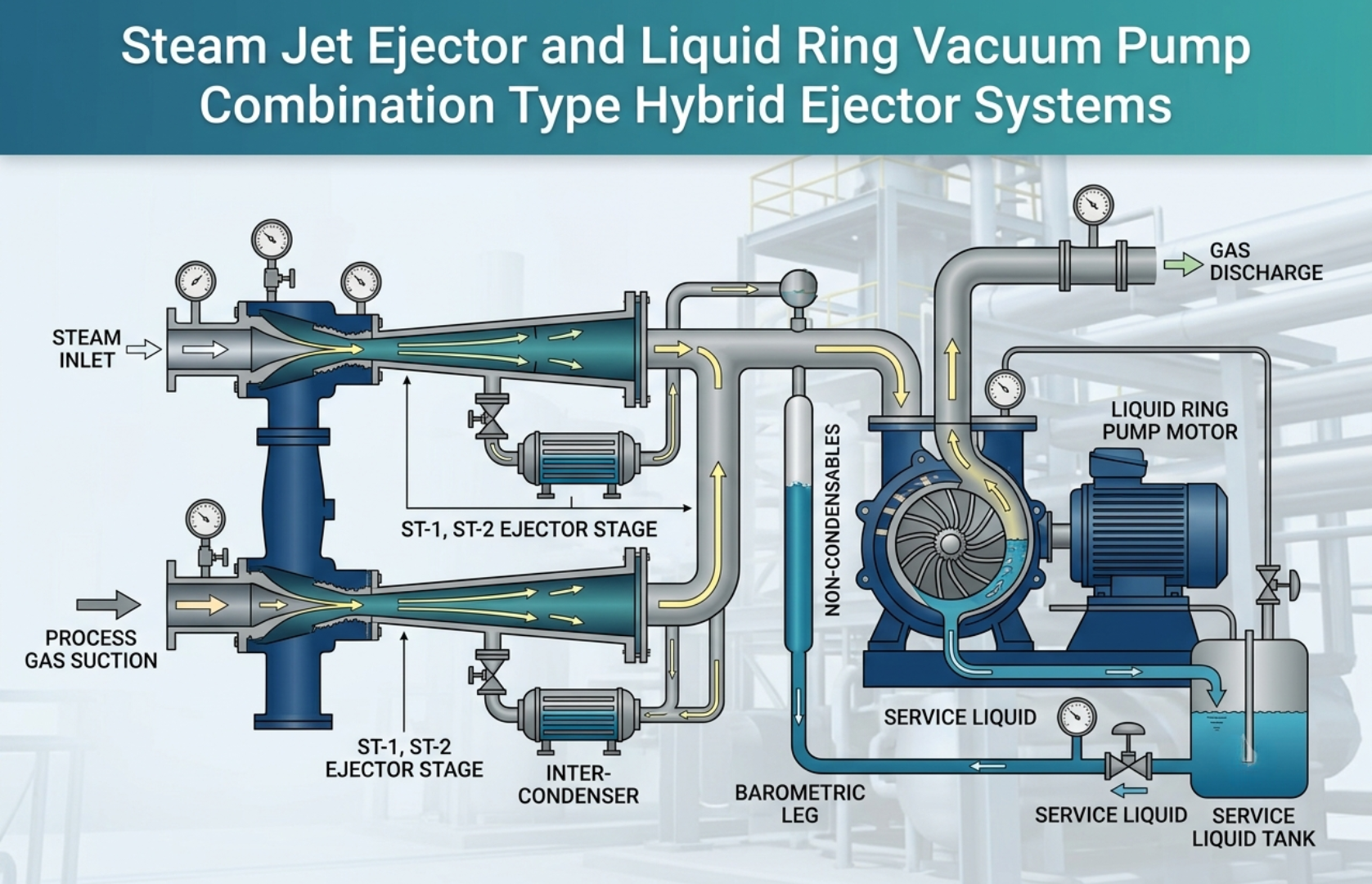
In today’s industrial landscape, reducing operating costs while maintaining process efficiency is a priority for every manufacturing facility. Industries such as chemical processing, edible oil production, pharmaceuticals, power generation, refineries, fertilizers, and food processing are continuously seeking vacuum solutions that deliver reliable performance with lower utility consumption. This is where the Steam Jet Ejector and Liquid Ring Vacuum Pump Combination Type Hybrid Ejector System from Jet Flow Technologies offers a practical and efficient solution.
By combining the deep vacuum capabilities of a steam jet ejector with the energy efficiency of a liquid ring vacuum pump, hybrid systems provide a cost-effective approach to vacuum generation. The result is improved process performance, lower steam consumption, and long-term operational savings.
What Is a Hybrid Ejector System?
A hybrid ejector system is an advanced vacuum solution that integrates:
- Steam jet ejectors
- Liquid ring vacuum pumps (LRVP)
- Inter condensers and after condensers
- Control systems and associated piping
Unlike conventional multi-stage steam ejector systems that rely entirely on steam, hybrid systems use a liquid ring vacuum pump in the final stage. This significantly reduces steam consumption while maintaining the desired vacuum level.
At Jet Flow Technologies, hybrid ejector systems are engineered to provide:
- Reduced utility consumption
- Improved operational flexibility
- Lower environmental impact
- Reduced lifecycle costs
- Reliable vacuum performance
Understanding the Steam Ejector Working Principle
To understand how hybrid systems operate, it is important to know the steam ejector working principle.
A steam ejector converts pressure energy into velocity energy. High-pressure motive steam passes through a specially designed nozzle, creating a high-velocity jet that entrains process gases and vapors. Multi-nozzle and variable flow ejectors are helpful in this context. The mixture is then compressed and discharged at a higher pressure.
The process involves:
- High-pressure steam entering the ejector nozzle
- Conversion of pressure into velocity
- Creation of a low-pressure zone
- Suction of process gases and vapors
- Compression and discharge of the mixed stream
Because steam ejectors have no moving parts, they offer:
- High reliability
- Minimal maintenance
- Resistance to corrosive environments
- Long service life
These advantages make steam jet ejectors a preferred choice in demanding industrial applications.
Why Industries Prefer Hybrid Vacuum Systems
Reduced Steam Consumption
Traditional steam jet vacuum systems consume substantial amounts of steam. By replacing the final ejector stage with a liquid ring vacuum pump, hybrid systems significantly reduce steam demand.
Benefits include:
- Lower boiler load
- Reduced steam generation costs
- Lower cooling water consumption
- Improved plant efficiency
Better Energy Efficiency
Modern industries are focused on reducing energy usage and emissions.
Hybrid systems support:
- Lower thermal energy consumption
- Reduced carbon emissions
- Improved sustainability
- Better heat recovery opportunities
This makes them an ideal choice for organizations seeking energy-efficient vacuum technologies.
Improved Process Stability
Industrial processes often operate under varying conditions. Hybrid systems can efficiently handle:
- Fluctuating vapor loads
- Condensable gases
- Variable process conditions
- Aggressive chemical vapors
The steam jet ejector and liquid ring vacuum pump combination system provides stable operation even when moisture and condensable vapors are present.
Lower Maintenance Requirements
The steam ejector section requires minimal maintenance because it contains no moving components. Modern liquid ring vacuum pumps are designed for:
- Continuous operation
- Corrosion resistance
- Long service life
- Easy servicing
This combination ensures dependable performance and reduced downtime.
How a Multi-Stage Hybrid Ejector System Works
Depending on the required vacuum level, hybrid systems are typically configured as:
- Two-stage steam ejector plus liquid ring vacuum pump
- Three-stage steam ejector plus liquid ring vacuum pump
- Four-stage steam ejector plus liquid ring vacuum pump
For deeper vacuum applications, condensers are installed between stages to remove condensable vapors and reduce load on downstream equipment.
Typical operation includes:
- Initial vacuum generation by the first ejector stage
- Vapor condensation through inter condensers
- Additional vacuum creation through subsequent ejector stages
- Final discharge handled by the liquid ring vacuum pump
This arrangement maximizes overall system efficiency while reducing utility costs.
Key Components of a Hybrid Ejector System
Steam Jet Ejectors: Generate deep vacuum levels during the initial stages.
Inter Condensers: Reduce vapor load by condensing process vapors between stages.
Liquid Ring Vacuum Pump: Acts as the final vacuum stage while minimizing steam consumption.
After Condensers: Remove remaining condensable vapors before discharge.
Control Systems: Maintain stable vacuum performance and optimize utility usage.
At Jet Flow Technologies, every hybrid system is engineered to ensure efficient integration of these components for maximum performance.
Industries Using Hybrid Ejector Systems
Chemical Processing Plants
Applications include:
- Distillation columns
- Solvent recovery
- Vacuum drying
- Evaporation systems
- Crystallization processes
Refineries and Petrochemical Plants
Used in:
- Vacuum distillation units
- Hydrocarbon processing
- Gas recovery systems
Food and Edible Oil Industries
Suitable for:
- Deodorization
- Concentration processes
- Moisture removal
Pharmaceutical Manufacturing
Widely used for:
- Solvent evaporation
- Drying processes
- Sterile production operations
Key Factors Buyers Should Evaluate
When selecting a hybrid ejector system, consider:
| Factor | Importance |
| Steam consumption | Impacts operating costs |
| Required vacuum level | Determines system configuration |
| Gas composition | Influences material selection |
| Cooling water temperature | Affects condenser efficiency |
| Maintenance accessibility | Supports plant uptime |
Jet Flow Technologies works closely with customers to evaluate these parameters and recommend the most suitable solution.
Hybrid Systems vs Conventional Steam Ejector Systems
| Feature | Traditional Steam Ejector | Hybrid Ejector System |
| Steam Consumption | High | Lower |
| Energy Efficiency | Moderate | High |
| Maintenance | Low | Low to Moderate |
| Operating Cost | Higher | Lower |
| Environmental Impact | Higher | Reduced |
How Hybrid Systems Improve ROI
Many industries now evaluate vacuum systems based on total lifecycle cost rather than initial purchase price.
Hybrid systems deliver long-term savings through:
- Reduced steam consumption
- Lower cooling water requirements
- Improved uptime
- Reduced maintenance expenses
- Enhanced process efficiency
For continuously operating plants, these savings often provide a rapid return on investment.
Important Considerations Before Purchasing
Process Conditions
Evaluate:
- Required vacuum level
- Vapor load
- Gas composition
- Operating temperatures
Utility Availability
Assess:
- Steam pressure availability
- Cooling water supply
- Electrical infrastructure
Material Compatibility
For corrosive environments, consider:
- Stainless steel construction
- Special alloy materials
- Corrosion-resistant designs
System Integration
Customized engineering typically delivers superior performance compared to standard packaged solutions. Jet Flow Technologies designs hybrid systems based on specific process requirements to ensure maximum efficiency and reliability.
Future Trends in Hybrid Vacuum Technology
Industrial vacuum technology continues to evolve with innovations such as:
- Smart vacuum monitoring systems
- Automated vacuum optimization
- Advanced thermocompressor integration
- Reduced water consumption designs
- Sustainable engineering practices
As industries focus on efficiency and environmental responsibility, hybrid ejector systems are becoming the preferred choice for modern vacuum applications.
Conclusion
The combination of a steam jet ejector and a liquid ring vacuum pump has transformed industrial vacuum technology. Hybrid systems provide the reliability of traditional steam ejector technology while delivering the energy efficiency and operational flexibility required by modern industries.
Jet Flow Technologies offers engineered hybrid ejector systems designed to help industries achieve:
- Lower operating costs
- Improved process reliability
- Better energy efficiency
- Long-term operational flexibility
Whether used in chemical plants, refineries, edible oil facilities, pharmaceutical manufacturing, or power generation, hybrid ejector systems represent a smart investment for organizations seeking both performance and sustainability.
FAQs
What is a hybrid ejector system?
A hybrid ejector system combines a steam jet ejector with a liquid ring vacuum pump to create an efficient vacuum solution with reduced steam consumption.
Where are hybrid ejector systems commonly used?
They are widely used in chemical plants, refineries, food processing industries, pharmaceutical manufacturing facilities, and power plants.
Why are hybrid systems more energy-efficient?
They replace part of the steam-driven vacuum generation process with an electrically powered liquid ring vacuum pump, reducing steam consumption and operating costs.
Are hybrid systems suitable for corrosive applications?
Yes. With appropriate material selection, they can effectively handle corrosive gases and challenging industrial environments.
What vacuum levels can hybrid systems achieve?
Depending on the design and process requirements, hybrid systems can achieve very deep vacuum levels suitable for demanding industrial applications.